Thursday, August 7, 2025

The Benefits of a Home Inspection on New Home Construction


Ensuring Quality, Safety, and Peace of Mind for Homebuyers

Introduction

 Purchasing a newly constructed home is a milestone that promises modern amenities, energy efficiency, and minimal maintenance—at least, in theory. Many buyers assume that a home fresh from the builder’s hands is flawless, having been constructed to code under the supervision of project managers, superintendent, and quality assurance checks and city or county inspectors. However, even with the best of intentions and the latest standards, oversights and mistakes can occur. This is where a professional home inspection becomes not just a safeguard, but a wise investment.

A home inspection for new construction involves a thorough, unbiased evaluation of the property by a qualified inspector, ideally at various phases of the building process. It empowers buyers to address issues before they become costly or hazardous, ensuring the dream of a new home does not become a source of stress and regret. In this document, we delve into the benefits of conducting a home inspection on new home construction, highlighting why it is not just for older homes but crucial for brand-new properties as well.

1. Uncovering Construction Defects Early

Even new homes can have issues. Contrary to popular belief, the fact that a home is recently built does not guarantee it is free of flaws. Construction involves a complex orchestration of many trades—framers, plumbers, electricians, roofers, HVAC installers—each with their own tasks and timelines. Coordination challenges, miscommunication, tight deadlines, or inexperienced workers can all lead to overlooked errors.

A home inspection can reveal:

·         Poorly installed roofing or flashing that may lead to leaks

·         Improper sealing around windows and doors

·         Plumbing leaks, clogged drains, or improperly sloped pipes

·         Electrical outlets wired incorrectly or not functioning

·         HVAC systems that are not cooling or heating as intended

·         Missing insulation or insulation installed incorrectly

·         Foundation cracks or signs of settling

Catching these defects before you move in, or before the builder’s warranty expires, can spare you from expensive repairs and headaches down the line.

 2. Ensuring Code Compliance and Quality Standards

New homes must comply with local building codes, but code inspections are not as comprehensive as private home inspections. Municipal inspectors are often pressed for time, inspecting dozens of homes each day. Their focus is on compliance with minimum standards, not necessarily the long-term quality or craftsmanship.

A private home inspector:

·         Works for you, not the builder

·         Provides a detailed, unbiased evaluation of the property

·         May catch issues that code inspectors miss due to time constraints or scope limitations

You gain the confidence that your home not only meets code, but also meets your expectations for safety and quality.

3. Leveraging Builder Warranties Effectively

Most new homes come with a builder’s warranty, typically covering workmanship and materials for a year or more, and sometimes structural elements for up to ten years. A professional inspection allows you to identify and document problems while you are still covered.

The benefits include:

·         Creating a list of repairs for the builder to address before closing or during the warranty period

·         Establishing a record of issues found, which can be valuable if you need to make a warranty claim

·         Having leverage in negotiations with the builder to ensure work is completed to your satisfaction

This proactive approach maximizes the value of your warranty and ensures your home is delivered as promised.

4. Saving Money in the Long Run

The upfront cost of a home inspection is minor compared to the potential expenses associated with undetected problems. For example, a leaking pipe behind the wall can lead to mold growth, structural damage, and thousands of dollars in repairs if not discovered early. Electrical issues can create fire hazards, while insufficient insulation can inflate energy bills for years.

By identifying issues before they escalate, you:

·         Minimize future repair costs

·         Avoid disruptions to your daily life after moving in

·         Protect your investment and the resale value of your home

5. Peace of Mind and Reduced Stress

Buying a new home is a major financial and emotional commitment. The assurance that a qualified inspector has thoroughly examined your property, and that any issues have been addressed, can provide immense peace of mind. You can move in with confidence, knowing that your home is safe, sound, and ready for your family.

6. Educating the Homeowner

A good home inspector does more than just point out problems. They can walk you through your new home, explaining how systems operate, where shut-off valves are located, how to maintain appliances, and what to watch for over time. This education is invaluable for first-time homeowners or anyone unfamiliar with modern building materials and technology.

7. The Phased Inspection Advantage

For new construction, consider multiple inspections at key stages:

·         Pre-drywall inspection: Before walls are closed up, the inspector can check framing, electrical, plumbing, and insulation for proper installation and code compliance.

·         Final walkthrough inspection: After the home is completed, the inspector performs a comprehensive review of all accessible areas and systems.

·         Warranty (11th-month) inspection: About 11 months after closing, another inspection ensures that any issues that have developed are still covered by the builder’s warranty.

Each phase offers unique opportunities to catch problems that may only be visible at that stage.

8. Holding Builders Accountable

A private inspection sends a clear message to the builder: you expect quality and accountability. Most reputable builders welcome this scrutiny and are eager to resolve legitimate concerns. For less scrupulous builders, the knowledge that another set of expert eyes is reviewing their work can be motivation to adhere more closely to best practices.

9. Increasing Resale Value and Marketability

When it comes time to sell, documentation of professional inspections and subsequent repairs can be a strong selling point. Prospective buyers are reassured by evidence that the home was thoroughly checked from the start and that issues were resolved proactively.

10. Addressing Safety Concerns

Even new homes can harbor safety hazards that are not apparent during a casual walk-through. Loose stair railings, improperly installed smoke detectors, missing GFCI outlets, or venting issues can put your family at risk. A home inspector’s trained eye ensures that your home is not just comfortable, but truly safe.

Conclusion

A home inspection on new construction is more than a formality—it is a cornerstone of smart homeownership. It uncovers hidden flaws, protects your investment, ensures safety and quality, and provides the peace of mind every new homeowner deserves. Whether you’re buying your first home or your fifth, don’t skip this critical step. The relatively modest cost and effort required can yield significant dividends, both financially and emotionally, for years to come.


Wednesday, January 29, 2025

How a Heat Pump Works

How a Heat Pump Works in Both Heating and Cooling Seasons

Heat pumps are versatile systems designed to provide both heating and cooling to a space by transferring heat rather than generating it. This makes them highly efficient and environmentally friendly. They operate on the principle of heat transfer, moving heat from one place to another, depending on the season.


Operation During the Heating Season

During the heating season, the heat pump extracts heat from the outside air, even in cold temperatures, and transfers it indoors. The process involves several key components, including the evaporator coil, compressor, condenser coil, and expansion valve.

Step-by-Step Process

• Evaporation: The refrigerant absorbs heat from the outside air through the evaporator coil, causing it to evaporate and turn into a gas.
• Compression: The compressor then compresses the gaseous refrigerant, raising its temperature and pressure.
• Condensation: The hot, high-pressure refrigerant gas passes through the condenser coil inside the home, releasing its heat and condensing back into a liquid.
• Expansion: The expansion valve reduces the pressure of the liquid refrigerant, cooling it down before it returns to the evaporator coil to start the cycle again.

Operation During the Cooling Season

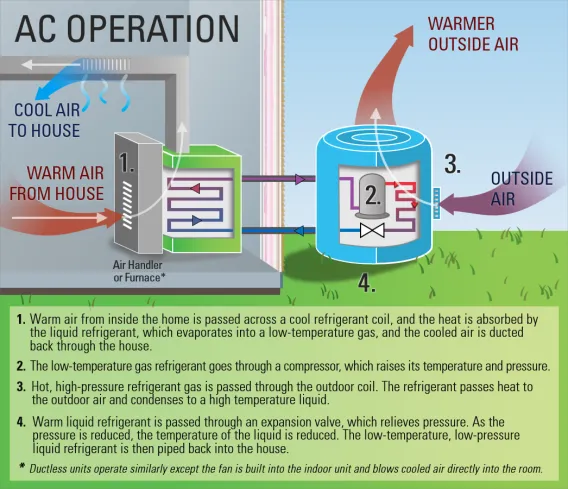
In the cooling season, the heat pump works in reverse. It extracts heat from the indoor air and releases it outside, providing a cooling effect inside the home.


Step-by-Step Process

• Evaporation: The refrigerant absorbs heat from the indoor air through the evaporator coil, evaporating into a gas.
• Compression: The compressor increases the temperature and pressure of the gas refrigerant.
• Condensation: The hot, high-pressure gas passes through the condenser coil outside, releasing heat and condensing back into a liquid.
• Expansion: The expansion valve lowers the pressure of the liquid refrigerant, cooling it before it returns to the evaporator coil indoors.

The Defrost Cycle

One of the critical nuances of heat pump operation during the heating season is the defrost cycle. When the outdoor temperature is low, moisture in the air can freeze on the outdoor coil, reducing the heat pump's efficiency. The defrost cycle is designed to remove this frost and maintain the system's effectiveness.

How the Defrost Cycle Works

• Detection: The heat pump monitors the outdoor coil's temperature and initiates the defrost cycle when necessary.
• Reversal: The system temporarily reverses its operation, switching to cooling mode to direct warm refrigerant to the outdoor coil.
• Heating the Coil: The warm refrigerant heats the outdoor coil, melting the accumulated frost.
• Completion: Once the frost is melted, the system switches back to heating mode, resuming normal operation.
The defrost cycle is essential to ensure that the heat pump operates efficiently and effectively throughout the heating season, preventing frost buildup that can impede performance.
In conclusion, heat pumps offer an efficient solution for both heating and cooling needs by transferring heat between the indoors and outdoors. Understanding their operation and the importance of the defrost cycle highlights their capability to provide consistent comfort across different seasons.


What is a Smart House

 What is a Smart House? 


 Understanding Smart Homes and the Devices That Make Them

A smart house, also known as a smart home, is a residence that uses internet-connected devices to enable the remote management and monitoring of systems and appliances such as lighting, heating, and security. Through the use of sophisticated technology, a smart house provides homeowners with greater control, convenience, and energy efficiency.

Components of a Smart House

A smart house is comprised of various interconnected devices and systems that communicate with each other to optimize the living environment. These systems can be controlled via smartphones, tablets, or voice-activated assistants, making it easy for homeowners to manage their home from anywhere in the world.

Types of Smart Devices and Tools

A variety of devices and tools are available to transform a conventional home into a smart home. Here are some of the key categories:


1. Smart Lighting

Smart lighting systems allow you to control the brightness, color, and timing of your lights through an app or voice commands. Examples include Philips Hue and LIFX bulbs. These systems can be programmed to switch on and off automatically based on your daily routine or in response to specific events, such as sunset or your arrival home.

2. Smart Thermostats


Devices like the Nest Learning Thermostat and the Ecobee SmartThermostat help regulate your home’s
temperature efficiently. They learn your habits and adjust the heating and cooling accordingly, ensuring comfort while saving energy. These thermostats can also be controlled remotely, allowing you to adjust settings even when you are not at home.


3. Smart Security Systems

Enhanced security is a major benefit of smart homes. Systems such as the Ring Alarm and Arlo
Security Cameras provide 24/7 monitoring and real-time alerts to your phone. Smart locks like the August Smart Lock can be locked or unlocked remotely, and you can even grant access to trusted individuals without needing a physical key.


4. Smart Appliances

Kitchen appliances have also been modernized to sync with your smart home network. For instance, the Samsung Family Hub refrigerator allows you to view its contents from your phone, while the LG ThinQ oven can be preheated remotely. These appliances often come with features that help manage energy usage and improve convenience.


5. Smart Entertainment Systems

Smart TVs and audio systems, like those from brands such as Samsung, LG, and Sonos, can be integrated into your smart home setup. These devices allow you to stream content from various platforms, control playback with voice commands, and even create multi-room audio experiences.

6. Smart Hubs and Voice Assistants

The control center of a smart home often revolves around smart hubs and voice assistants. Devices like the Amazon Echo, Google Nest Hub, and Apple HomePod serve as central points for managing your smart devices. They use voice commands to perform tasks, provide information, and control other connected devices.

7. Smart Plugs and Outlets

Smart plugs and outlets from brands like TP-Link and Belkin enable you to control any plugged-in device remotely. These tools are particularly useful for automating lamps, fans, and other small appliances, making it easy to schedule their operation and monitor energy consumption.

8. Smart Irrigation Systems

Maintaining a lush garden or lawn can be simplified with smart irrigation systems like the Rachio Smart Sprinkler Controller. These systems can be programmed to water your plants based on weather conditions and soil moisture levels, ensuring efficient water usage.

9. Smart Window Treatments

Automated blinds and shades, such as those from Lutron and Somfy, can be scheduled to open and close at specific times or in response to sunlight levels. This not only enhances privacy and comfort but also contributes to energy efficiency by controlling the amount of sunlight entering your home.

10. Smart Sensors

Smart sensors, including those for water leaks, smoke, and carbon monoxide, provide early warnings of potential hazards. Brands like First Alert and Fibaro offer sensors that can send immediate alerts to your phone, allowing you to take swift action to prevent damage or harm.

Benefits of a Smart House

The integration of these devices offers numerous advantages, including:

• Convenience: Automation of daily tasks and remote control of devices simplify home management.

• Energy Efficiency: Optimized energy use reduces utility bills and environmental impact.

• Enhanced Security: Real-time monitoring and alerts provide greater peace of mind.

• Personalization: Customized settings and routines cater to individual preferences and lifestyles.

• Increased Home Value: Smart home features can boost the market value and appeal of your property.

Conclusion

Converting your house into a smart home involves the integration of various devices and systems designed to work together seamlessly. From lighting and security to appliances and entertainment, the possibilities are vast. As technology continues to evolve, the future of smart homes promises even greater innovations, ensuring that our living spaces become more intelligent, efficient, and enjoyable.


The Benefits of WiFi Enabled Smart Irrigation TImers


The Benefits of a WiFi Enabled Smart Irrigation Timer


The Old Way of Water Management for Gardens and Lawns

Revolutionizing Water Management for Gardens and Lawns

A WiFi-enabled smart irrigation timer is a cutting-edge technology that has transformed the way we manage water for gardens, lawns, and landscapes. This innovative device offers a plethora of benefits that cater to both environmental concerns and practical needs. Here, we explore the myriad advantages of adopting a smart irrigation timer in your outdoor space.

1. Efficient Water Management

One of the most significant benefits of a WiFi-enabled smart irrigation timer is its capacity to optimize water usage. Traditional irrigation systems often overwater or underwater plants, leading to wastage and inefficient use of resources. A smart timer, however, can adjust watering schedules based on real-time data such as weather forecasts, soil moisture levels, and plant requirements. This ensures that only the necessary amount of water is used, promoting conservation and sustainability.

2. Remote Control and Monitoring

With the integration of WiFi technology, smart irrigation timers can be controlled and monitored remotely via a smartphone or tablet. This feature is particularly beneficial for frequent travelers, property managers, or anyone with a busy schedule. Users can easily adjust watering schedules, turn the system on or off, and receive notifications about system performance or potential issues, all from the convenience of their mobile device.

3. Customizable Scheduling

Smart irrigation timers offer highly customizable scheduling options that allow users to set specific watering times and durations based on the unique needs of their landscape. This flexibility ensures that different plants receive the appropriate amount of water at the right time, promoting healthier growth and reducing the risk of overwatering or underwatering.

4. Weather-Based Adjustments

One of the standout features of a WiFi-enabled smart irrigation timer is its ability to make weather-based adjustments. By accessing local weather data, the system can automatically skip watering sessions during rainy periods or increase watering during hot, dry spells. This not only conserves water but also prevents waterlogging and root rot, which can occur when plants receive too much moisture.

5. Cost Savings

Efficient water management translates to significant cost savings on water bills. By reducing water wastage and ensuring that irrigation is only done when necessary, smart irrigation timers can help homeowners and businesses lower their utility expenses. Additionally, some regions offer rebates or incentives for adopting water-saving technologies, further enhancing the financial benefits.

6. Environmental Impact

Reducing water consumption has a positive impact on the environment. By conserving this precious resource, smart irrigation timers contribute to the preservation of local water supplies and ecosystems. Furthermore, efficient watering practices reduce the runoff that can carry fertilizers and pesticides into nearby water bodies, thereby minimizing pollution and protecting aquatic life.

7. Enhanced Plant Health

Plants thrive when they receive the right amount of water. Overwatering and underwatering can stress plants, making them more susceptible to diseases and pests. A smart irrigation timer ensures that plants receive consistent and appropriate hydration, leading to healthier, more robust growth. This improved plant health enhances the overall aesthetic appeal of the garden or landscape.

8. Easy Installation and Integration


Modern smart irrigation timers are designed for easy installation and integration with existing irrigation systems. Many models come with user-friendly interfaces and step-by-step guides, making it simple for homeowners to set up and start using the device. Additionally, these timers can often be integrated with other smart home technologies, creating a seamless and automated home ecosystem.

9. Data-Driven Insights

Smart irrigation timers collect and analyze data related to water usage, weather patterns, and plant health. This data provides valuable insights that can help users make informed decisions about their irrigation practices. Over time, these insights can lead to further optimization of watering schedules and improved water management strategies.

10. Increased Property Value

Investing in a WiFi-enabled smart irrigation timer can enhance the value of a property. Potential buyers are increasingly looking for eco-friendly and technologically advanced features in homes. A smart irrigation system not only showcases a commitment to sustainability but also indicates that the property is equipped with modern conveniences that make maintenance easier and more efficient.

11. Peace of Mind

Finally, a smart irrigation timer offers peace of mind to homeowners and property managers. Knowing that the garden or lawn is being watered efficiently and effectively, even when they are not physically present, reduces stress and allows for more enjoyment of the outdoor space. This assurance is invaluable, particularly during times of travel or busy schedules.

In conclusion, a WiFi-enabled smart irrigation timer is a valuable investment for anyone looking to enhance their water management practices, promote plant health, and contribute to environmental conservation. With its array of features and benefits, this technology is poised to revolutionize the way we care for our gardens and landscapes, offering convenience, efficiency, and sustainability in one smart package.


Monday, November 1, 2021

NEW HOME INSPECTIONS AND TYPES


So, you’re having a home built. You should ask yourself a few questions.

1.     What type of inspections are available for new home construction?

2.     When should you have the home inspections conducted?

We get asked these questions a lot. There are three types of inspections associated with new construction homes:

1.      Pre-drywall

2.       Final

3.      One-year warranty.

Let’s discuss all three.

PRE-DRYWALL INSPECTION


The American Society of Home Inspectors (ASHI) has a Standard Of Practice for conducting residential pre-drywall inspections, and this is the standard that we at AmeriSpec Inspection Services follow.

This standard address what’s included, what isn’t, and what gets reported on.  It’s very similar in detail to the ASHI Standards of Practice for Home Inspections, though the scope, is far different.

Per the ASHI Pre-Drywall Inspection SOP, this inspection should take place after the following components have been installed:

A. Foundation components,
B. Floor, wall, and roof structural components,
C. Plumbing, electrical, and rough-in components,
D. Windows and exterior doors.

Simply said, this inspection should happen before the drywall is installed and just prior to insulation. These inspections normally take about one to one and one-half hour to conduct, and they’re priced accordingly.

FINAL INSPECTION

The final inspection is really a standard home inspection, but it is called a ‘final’ or “preclosing” inspection.  This inspection should be done after the home has been completely built and just prior to your “walk through” with the builder. If the builder is running behind on schedule, the home inspection should be re-scheduled. A home inspection conducted too soon leads to confusion and misunderstandings between all parties.

If you had to choose only one type of inspection, it should be the final inspection. This is the most important one.

ONE YEAR WARRANTY INSPECTION

A one-year warranty inspection, or commonly called aa 11-month warranty inspection, is simply a standard home inspection with a different name. The difference between a one-year warranty inspection and a final inspection is timing. One-year warranty inspections should be conducted before the builder’s one-year warranty expires.

The vast majority of our one-year warranty inspection clients are people who bought new construction homes without an inspection and later regretted it. They’ve had way more problems with their new home than they had bargained for, and they want to know what else is going on.

CONCLUSION


If you’re having a new home built, get a pre-drywall inspection and a final inspection. If you’re buying a new home that has already been built, get a home inspection. If you’ve already purchased a new home but you skipped the inspection, schedule a one-year warranty inspection before your warranty expires.

For information about AmeriSpec please visit our website at www.inspectjax.com or give us a call at 904-448-5016


Saturday, June 27, 2020

Home Inspectors Are Not All The Same

How do I choose or qualify a Home Inspector?Compare, Comparison, Options, Choice


As a realtor, can you help your client choose a home Inspector?  

Pros, And, Cons, Compare, Choice
I would say emphatically, yes. I would also say you have duty to ensure your client is choosing wisely.

Entry into the profession of Home Inspection is easy. Many enter the business because of the promise of financial rewards (wealth) and don’t realize the costs (expenses). Most fail.
Experience counts in this business.   

Experience. 


Graduation Hats, Throw, GraduationHow long has the inspector been in business?  If the inspector works for a multi inspector firm those inspectors are vetted by the owner, have conducted additional training beyond initial schooling, have conducted numerous ride-a-longs, practice inspections, and have assisted the owner/principle inspector/mentor for weeks to months before they can inspect alone. This ensures established protocols, proper communications with all parties, and consistent reporting, which is important to future referrals.


Insurance 

There are several types of insurance a home inspector in Florida can carry. The short list is General Liability, Professional Liability (Errors and Omissions), Workers Compensation, and Vehicle Insurance.

General Liability

In Florida, the Inspector is only required to carry a minimal General Liability Policy set by Florida Statutes. G&L Insurance typically covers only things that may happen on the day of the inspection.

Professional Liability (Errors and Omissions)


What if the inspector was grossly negligent or made an outrageous omission in the conduct of his/her inspection? If the don’t have professional liability insurance, its up to the Inspectors good will. Is he or she going to be around to solve the problem? E&O Insurance may help.

Workers Compensation

What if the inspector is electrocuted, falls through the ceiling, or off the roof and is seriously injured. If the inspector is Workers Compensation Exempt, and the can be, this can be catastrophic for the owner of the home. The injured Workers Compensation Exempt Inspector my have only one recourse to pay for his medical expenses, and that’s suing the Home Owner or seek remedy through the home owners insurance policy.   

Staff

Office, Business, Accountant, AccountingDoes the Inspection company have a professional staff? Can they easily be reached to schedule inspections, answer routine questions, conduct post inspection follow-up and handle other issues that may arise?

Additional Services or Offerings

Many larger firms offers additional services at the time of the home inspection such ass Wood Destroying Organism Inspections, Four Point Insurance Letters, Uniform Wind Mitigation Reports, Swimming Pool Inspections, Dock/Bulkhead, Pre-drywall, Pre-Listing Inspections, Commercial Inspections, and other convenient services. Other offerings such as Repair Price (a tool to easily gather repair estimates), HomeBinder (an on line reference site for home ownership), warranty products, etc. 

AllSpec Services 


AllSpec Services is a fully licensed and Insured Home and Building Inspection Company servicing the greater NE Florida area since 1992. We have a full time, professional office staff to assist you. Please call our office at (904) 448-5016 should you have ant questions or would like to schedule an inspection.


Wednesday, December 11, 2019

Home Inspectors Are Not The Same

Good morning.

I am going to RANT a little bit this morning so please forgive me in advance.

LICENSING

One of my greatest concerns as a long practicing home inspector in Florida (since 1992) is the easy entry into our profession. Since the advent of licensing in Florida, most consumers and real estate agents consider Licensed Home Inspectors to be all the same. We are not!

There are four exams available for licensing in Florida. The National Home Inspectors Exam (NHIE) is considered a high stakes exam and is the only psychometrically valid exam offered. More information on the various tests available can be found below. I encourage each of you that are real estate professionals to review/investigate/qualify home inspectors on your referral list.

• National Home Inspector Examination (NHIE)
• Florida Association of Building Inspectors (FABI)
• InterNACHI Florida Home Inspector Licensing Examination
• Association of Construction Industry’s Certified Home & Prop

All Inspectors at AllSpec Services are required to pass
the NHIE prior to being a practicing inspector in our firm.

INSPECTION REPORTS

Length of Report. I am amazed at what some of my real agent friends are sharing with me regarding Home Inspection Reports. They are becoming unnecessarily long (I have seen them exceed 50 plus pages and many times much longer). I would think the length of these reports must be overwhelming to both the home buyer and the real estate agent?

Clutter. Oftentimes these reports are cluttered with hundreds of pictures that simply don’t enhance the report or provide clarity regarding the defect but are used as a mean to protect the inspector (I was here and saw this).

Boiler Plate. Most of these long-winded reports are also filled with boiler plate language, disclaimers, and useless filler that should have been addressed via the inspection agreement and the standards of practice. Why clutter the inspection report with this information? I believe this is due to the Inspection Software Industry driving our profession into the wrong direction of minutia. I believe home buyers and real estate professionals want clearly written, easily understood reports.

Constant Referral to Others. Many home inspectors lack the mental ability our courage to make the call. If it’s wrong, its wrong. That’s why we are here. The constant referral to call in outside experts is a method to reduce the risk and liability, on behalf of the inspector. It is burdensome and decreases the credibility of our profession. Make the call!

Okay, I’m done now.

Monday, September 23, 2019

HOME INSPECTION GUIDE FOR BUYERS AND SELLERS


ALLSPEC SERVICES

 5771 Mining Terrace, Suite 101
Jacksonville, FL 32257
(904) 448-5016

AllSpec Services has been inspecting homes and commercial buildings in the greater Jacksonville since 1992.  I am confident that we have a team member that will please your during your purchase and or sale of real estate. Please give us the opportunity to serve you. Please take a few minutes to rear our guide for buyers and sellers

HOME INSPECTION GUIDE FOR BUYERS AND SELLERS 


WHO NEEDS A HOME INSPECTION 

WHAT IS A HOME INSPECTION 

OF SPECIAL INTEREST TO HOME BUYERS 

WHEN TO ARRANGE A HOME INSPECTION 

OF SPECIAL INTEREST TO SELLERS  

PREPARING FOR A HOME INSPECTION  

ADDITIONAL NOTES TO HOME SELLERS 

 BEYOND HOME INSPECTIONS 

 OF INTEREST TO REAL ESTATE AGENTS 

 Home inspections are an essential component of real estate transactions for millions of buyers, sellers, and real estate agents. Whether you are shopping for a previously-owned house or a brand new house, an inspection provides insight to the condition of the home you are buying. If you are putting your house on the market, an inspection helps hasten the sale and can generate a higher price. And if you are a real estate agent, a professional home inspection report serves as an ideal marketing tool that also helps protect you against post-closing hassles.

In essence, a home inspection is a visual examination of a house and property. When performed by a qualified professional, it includes:

 A thorough visual inspection of the structure (inside and out, from foundation to roof).

 An examination of all major systems.

 An objective evaluation of the condition of more than 400 items.

 A printed report covering all findings and identifying potential concerns.

The following pages provide a more detailed description of a home inspection and additional useful information on the following:

 Who needs a home inspection.

 What a home inspection is ... and is not.

 Benefits of a home inspection

 Preparing for a home inspection.

 How to choose a home inspector.

 WHO NEEDS A HOME INSPECTION? 

You do if you are shopping for a home. 

A home inspection can help you avoid costly and unpleasant mistakes and provide peace of mind. It will help you identify the house that is right for you, and alert you to potential concerns prior to closing the deal. It also will teach you about your home and its operating systems.

 You do if you want to sell your house.

A pre-marketing home inspection provides the seller with an objective evaluation of the home's condition before the house is put on the market. Consequently, you are provided with guidance in preparing your house for maximum sales appeal. A home inspection not only encourages a faster sale and a better price, it also helps ensure compliance with disclosure requirements.

You do if you are a homeowner. 

Even if you do not intend to sell your home, a thorough inspection of your house and property every four to five years can yield significant returns. First and foremost, a professional inspector can identify conditions that may be present or may lead to safety hazards for family members. Furthermore, periodic inspections can help detect potential problems early, before they become severe and costly.

This guide has been created to educate consumers looking to fulfill the increasing demand for home inspections across the country; especially as real estate values fluctuate, disclosure requirements intensify, home buyers become more cautious, and litigation against sellers and real estate agents climbs to unprecedented levels.

 As recently as 1980, it was "caveat emptor" or "buyer beware" where fewer than one in ten homes sold were inspected. Today that amount is still only four times greater, but growing rapidly. In past decades, when the services of professional home inspectors were virtually nonexistent, buyers were forced to gamble on hidden problems, unexpected repair costs, and sometimes major disasters. Today's smart consumer demands better information.

A growing number of states and local governments now require full disclosure of a home's condition before a property is sold, and more and more real estate boards include inspection clauses in purchase agreements. Nevertheless, according to the Federal Trade Commission, after moving into their houses 42% of the buyers face unexpected repairs costing an average of $500, and more than one in nine are forced to spend over $1000 for repairs.

WHAT A HOME INSPECTION IS ... 

 A home inspection is a thorough visual examination of the home and property. 

The process usually takes two to three hours, during which time the house is examined from the ground up. The inspection includes observation and, when appropriate, operation of the plumbing, heating, air conditioning, electrical, and appliance systems, as well as structural components: roof, foundation, basement, exterior and interior walls, chimney, doors, and windows.

When conducted by a professional, a home inspection covers about 1,000 check-points in approximately 400 items around the home. 

Findings should be provided to you in the form of a comprehensive report. It is vital that such a report include an objective evaluation of the condition of the home, clearly relating existing defects and indicating potential problems.

AND IS NOT...

A home inspection is not an appraisal. And vice versa. 

An appraisal is the formal process of estimating a property's value as it relates to a mortgage loan or mortgage insurance. It does not itemize defects or reflect potential problems in the home. Even an FHA appraisal does not attest to the condition of a home. In fact, the U.S. Department of Housing and Urban Development encourages home buyers to use private inspection services, and authorizes that closing costs may include inspection fees of up to $200.

A home inspection report is not a warranty. 

Because a home inspection is a visual examination of the home and operating systems, it is not technically exhaustive. There is no assurance, expressed or implied, that equipment will not break down at some future date. However, such protection is available when a home inspection is complemented by a home warranty. When the services are used in conjunction with one another, a home warranty covers the items that were serviceable at the time of the inspection and subsequently fail due to normal wear and tear.

A home inspection does not detect every conceivable flaw. 

It is an inspection of those area and items that can be seen. Home inspectors cannot see through foundations, floor or walls, and cannot inspect areas or items that are inaccessible.

 OF SPECIAL INTEREST TO HOME BUYERS


Buying a home is largely an emotional experience. Sometimes it's love at first sight. But often love is blind, and many buyers learn too late of such unseen conditions as cracked foundations, deteriorated plumbing, worn out heating systems, or dangerous wiring.

A professional home inspection is your best defense against such pitfalls and their consequences, such as:

  • Costly repairs. 
  • Inconvenience. 
  • Animosity. 
  • Disappointment. 

You may have some knowledge of construction, or a friend or relative may have a background in plumbing or carpentry, but there is no substitute for the objective eye of a skilled home inspector who knows where to look, what to look for, and how to evaluate hundreds of key points throughout the property. Unlike the home buyer whose observations are likely to be partial, the home inspector performs his role with an unbiased attitude.

Keep in mind, a home purchase is one of the largest long term investments of your life. As a result, you need to know as much as possible about your prospective purchase. By identifying existing or potential areas of concern, the inspection report will help secure your investment, avoid post-closing surprises, and provide you with peace of mind. An insightful report is fundamental to making the right buying decision.

WHEN TO ARRANGE A HOME INSPECTION 

 As soon as you become serious about the purchase of a home, you should consider a professional inspection. When you come to a decision to purchase a particular house, have a protective clause written into the purchase agreement which provides you with the right to have a home inspection company conduct a complete general home inspection.

BE THERE 

It is important that you, as the home buyer, be present during the two to three hour inspection. By accompanying the inspector you will gain additional insight.

 See first hand the condition of each key component throughout the house and property so you will have a better understanding of your house and of the inspection report.

 Allay concerns about findings which, on paper, may seem distressing but in fact may be superficial. For example, the inspector might explain that an alarming noise coming from an appliance can be quieted by some lubricant; that an unsightly column needs only a coat of paint, or that the problem that caused a water spot has previously been corrected.

 Learn about the operation of your new home-how the heating system works, how to control pilot lights, how to turn on various appliances and components, where shutoffs are to save time and avoid frustration. The inspector can point out maintenance needs and procedures and explain how and when to check items needing periodic monitoring.

 Have all of your questions and concerns addressed immediately as they arise.

Prior to the inspection, prepare a list of questions or concerns about the property. Relate these to the inspection company in advance to ensure that such matters will be properly addressed and that any special arrangements can be made if necessary. Bring your list to the inspection.

OF SPECIAL INTEREST TO SELLERS 

 Are you planning to put your house on the market? Do you want to sell it faster? Would you like top dollar? Are you interested in reducing negotiating time? Do you want to protect yourself from potential lawsuits?

For these and other reasons, a home inspection is a prudent first step in the process of selling your home. You, as the seller, must present the most saleable property possible. A home inspection report will reveal the current condition of your house with specific evaluations of more than 400 items, and guide you toward enhancing the value and marketability of your property.


Most problems in a house are minor and can be rectified easily and inexpensively; chipped paint, doors or windows that stick, an air conditioner that wheezes, a filter that is dirty, etc. Such shortcomings are overlooked by sellers who have lived with them for years, but they are focused on by buyers. If the perceived problems do not derail the sale, they nevertheless provide grounds for price negotiation.

Not only does the pre-sale inspection enable you to attend to problems before the house is put on the market, it also removes any questions-for you and home buyers-about the condition of your home. Buyers are positively influenced by a professionally produced home inspection report, which improves the speed, price, and likelihood of a sale.

Some home sellers elect not to correct every defect reflected in the inspection report. Instead, they acknowledge the defects to buyers and explain that the asking price has been adjusted to reflect the estimated cost of repairs. Such candor tends to shorten negotiation time because buyers have fewer objections that could thwart a sale. In addition to facilitating the sale of a home, an inspection helps the homeowner comply with full-disclosure real estate laws that are being enacted by more and more states. By focusing on the condition of your property, you are less likely to overlook a defect or material fact for which you later could be held liable. In recent years, home buyers have been more inclined to file law suits against sellers involving allegations of misrepresentation, negligence, and fraud. Some judgments against sellers have been severe, even when the omission of facts was unintentional.

PREPARING FOR A HOME INSPECTION

If you, as the seller, have arranged to have your home inspected, you should plan to accompany the inspector during the entire process. If it is a buyer initiated inspection, it would be preferable if you were not present. You must be notified in advance of any inspection. The real estate agent generally will schedule the inspection for a time convenient to both you and the buyer to allow you enough time to make preparations.

Whether the home inspection has been arranged by you, as the seller, or by the buyer, you can take several preparatory steps which will benefit you and facilitate the inspection process:

Make sure the inspector can access all areas of the house. 

Clear all furniture, boxes, clothes, toys and other personal items that may block access to the furnace, water heater, electrical panels, attic crawl spaces, etc. Inspectors will not enter inaccessible areas.

If access to your attic crawl space is located in a closet, remove clothing, shoes, and other items. 

Not only might they be in the way, but as the hatch is removed, debris (dust, insulation, loose plaster) is likely to fall from the ceiling onto items left in the closet.

If you are expecting a visit from an inspector and prospective buyer: 

• Ensure that filters are clear in air conditioners, heaters, vents, drains, etc.

• Clear out areas under sinks so they can be inspected.

• Have the house cleaned thoroughly.

The fewer problems an inspector finds with the property, the better overall image the property presents to the prospective buyer. Obviously, it is to your advantage if the buyer hears the inspector saying, "Everything on this property is right except for a couple little issues here and there," rather than hearing a long list of concerns.

ADDITIONAL NOTES TO HOME SELLERS 

The home inspector may override your timers (such as automatic sprinklers, outdoor lighting, etc.). You should check them after the inspection to ensure they are reset properly. Remember to allow for 2-3 hours for the inspection.

CHOOSING A HOME INSPECTOR 


While most states require no formal licensing of home inspectors, reputable companies adhere to the rigid standards of practice established by the American Society of Home Inspectors®. Many state inspection organizations (the California Real Estate Inspectors Association®, the Florida Association of Building Inspectors®, the Texas Association of Real Estate Inspectors®, just to name a few) impose standards as well.

Qualified inspection companies will provide a sample report to substantiate that they abide by industry standards. One of the key standards is that ethical inspectors neither perform repairs nor refer clients to repair companies (thus avoiding a conflict of interest). Obviously, inspectors who make repairs on homes they inspect are more likely to "find" defects.

Once you have arranged for a home inspection, plan to accompany the inspector for the entire procedure. You have the right to be there, and leading home inspection companies will encourage your presence. It helps you to better understand the findings in the report, and will reduce post-closing hassles. Don't forget your list of questions and items of concern. A thorough home inspection covers more than 1,000 items-everything from foundation to roof-and takes two to three hours, depending on the size of the property. The report should reflect the condition of about 400 items.


To help you choose a qualified company that will conduct a thorough inspection of your property and provide you with an objective report on the condition of your home, call several candidates and ask the following questions: 

 Do you follow industry standards? 

 Are you willing to supply me with a sample report? 

 Are you a full time home inspection company? 

 What other home services do you offer? 

 May I attend the inspection? 

 How much time will the inspection take? 

 When will the report be ready? 

 Do you perform repairs on items you inspect? 

 What will I receive with the inspection report? 

 What will be inspected? 

 How much will the service cost? 

 Do you carry errors and omissions and general liability insurance? 

 Do you provide an inspection agreement which defines the scope of the inspection? 

Also ask if they offer other benefits (such as repair manuals maintenance guides, or online versions such as HomeBinder, continued availability to answer questions), and will they provide a refund if you are not satisfied with their work. When you receive sample reports, ensure they are thorough, easy to understand and narrative in format. How do they compare with reports sent by other companies? How do their fees compare with those quoted by competitors? Remember you get what you pay for. 

BEYOND HOME INSPECTIONS 

Extensive as it is, a home inspection is not all inclusive. Depending on your level of concern and the location of the house, you may want to consider the following optional services which generally can be performed in conjunction with the home inspection:

• WDO or Termite Inspection Although a pest inspection is no guarantee that termites will not infest your home in the future, it will provide a "wood-destroying pest and dry rot" report on any existing threat. Beware of termite inspectors who are also exterminators and/or provide repairs.

• 4.0 Insurance Inspections Some insurance companies will require a 4.0 Insurance Letter to state the conditions of the Roof, heating and cooling system, plumbing type and water heater, life expectancy of roofing materials and electrical safety items. Check with your insurance agent.

• Uniform Wind Mitigation Form Another insurance item where the inspector will complete a form for your use that may provide you with some discounts on your home owners policy. Check with your insurance agent.

• Swimming Pools A visual and operation assessment of the pool shell, coping, circulation equipment, timers, lighting, and heater (if equipped).

• Phased Inspections An inspection done while you  your new home is being built. Commonly called a pre-drywall inspection. This inspection covers slab, framing, electrical, plumbing, and roofing, prior to installation of insulation and drywall.

• New Home Inspection An inspection conducted just prior to your new home walk through. This inspection is intended to assist you in understanding your new home and to list those items that are deficient and/or need additional attention. 

• One Year Anniversary Inspection An inspection conducted just prior to your builders one year anniversary. This inspection is to document any items that you may wish to have your builder address prior to your one year anniversary.

OF INTEREST TO REAL ESTATE AGENTS 

The competitive nature of the real estate industry suggests that agents no longer can afford to rely solely on traditional marketing efforts. Home inspections offer a competitive edge. Thousands of agents who routinely counsel buyers and sellers to arrange for home inspections have reported:

  • Reduced liability. 
  • Less buyer discomfort. 
  • Curtailed buyer remorse. 
  • Improved image and credibility. 
  • Less litigation. 
  • More sales. 
  • Less negotiation. 
  • Reduced selling time. 


With a detailed home inspection report in hand, the real estate agent need not continually overcome buyer objections related to the condition of the property. If the inspection findings are taken into account when determining the asking price, the buyer is discouraged from negotiating a lower price. 

Furthermore, insight gleaned from an inspection report allows the seller to enhance the appearance and condition of the property before it reaches the market.

Overall, a professional home inspection report lends credibility and stature to the image of the real estate professional. It says the firm and its sales associates are genuinely concerned with the best interests of both buyer and seller, thereby reflecting on the real estate agent's integrity. Such impressions encourage referrals and tend to curtail buyer's remorse, litigation, and even claims against E&O insurance. Consequently, inspections can have a decidedly positive impact on the insurance rates and liability of realty firms.

IN CLOSING ... 

The home inspection benefits all parties involved in the real estate transaction. For further information or to arrange an inspection with a qualified home inspection company, consult your local real estate professional.

Gutters and New Homes

Wednesday, October 31, 2018

Re-Inspections: Should I or Shouldn’t I Recommend?


Re-Inspections: Should I or Shouldn’t I Recommend?

As a longtime Home Inspector servicing the greater Jacksonville Florida market I will emphatically say, it depends.

If I had my way and could wave my magic wand, there would be no repairs conducted by a seller because, it’s been my experience, they will always be half done, not done, or done in an amateurish manner. Seemingly the seller is trying to maximize their sales price, minimize their pain, and maximize their gain (if any).

Ideally, the property buyer is always in a better position to make the repairs under their direct supervision, that way the decisions, priority of work, total costs, and choice of contractor is theirs to make.

I fully realize that most real estate contracts simply don’t work that way in our market. The Buyer has a home inspection, accepts or rejects conditions discovered, then places demands on the seller, who either accepts or rejects the demands of the buyer.

Repair/Replacement and Retreatment Agreement

Once you have acceptance of the Repair/Replacement and Retreatment Agreement there are several things you need to know as a profession real estate agent/property seller.

Things to Know

1.     According to Florida Statute 455.228, if you hire an unlicensed contractor, the Department of Business and Professional Regulations (D. B. P. R.) may issue a cease and desist order. They also may take you to Circuit Court, which has the authority to impose a civil penalty of up $5,000 for aiding and abetting unlicensed activity. You could also be liable for court cost.
2.     If you obtain a permit for an unlicensed contractor, you are held responsible for the work, not the contractor.
3.     If you hire an unlicensed contractor, you may actually pay more for the job than if you had hired a licensed contractor. Especially if the work is done incorrectly or never finished, you may have to pay twice or more for the same job to be corrected or finished.
4.     If the unlicensed contractor fails to pay his sub-contractors or suppliers, you may be required to pay them even though you have already paid the contractor.
5.     Plumbing, electrical, and heating and air conditioning work must be done only by contractors and craftsmen certified in those trades and require separate permits.
6.     Home improvement contractors must possess a license issued by the State of Florida as a general, building, or residential contractor.
7.     Roofing contractors are required to be certified or registered by the state.
8.     There is no such thing as a 'legal' jack-of-all-trades.
9.     An 'Occupational License' is not a regulatory license or a Certificate of Competency, but a tax for the privilege of engaging in or managing a business, profession, or occupation.
10. You may be held liable for injury on your property if the unlicensed contractor has no liability insurance or Worker's Compensation insurance.

So, its important that you and your sellers know their responsibilities as it relates to repairs.

The Process

Once complete the buyer may want someone to verify that the repairs requested have been completed. The Home Inspector may be asked to return to the property and conduct a verification of repairs.

He/she will want a copy of the executed Repair/Replacement and Retreatment Agreement and copies of all receipts and/or work orders prior to a revisit.

All parties must understand that the inspector will simply be verifying that the work has been done in a workmanlike manner and that all items have been addressed.

All parties should also understand that in many cases the scope of the work is not known to the inspector and will not be visible. He/she will only be able to state that there are visible signs that the repairs have been made. This fact emphasizes the importance of receipts and work orders.

Pitfalls

Waiting until the last minute to schedule the reinspection. The inspector could be busy and getting on the schedule can be difficult. Plan ahead. The also needs to understand this is not a free service and is relatively expensive.

Incomplete documentation. This creates heartburn to both the inspector and the buyer. The inspector needs documentation to track the requests and the buyer wants documentation for their permanent owner’s files.

Be prepared for missed items, items not done correctly or incomplete. In many cases the verification of repairs are done just prior to closing. This will certainly create heartburn to all sides. Please remember its not the inspector’s fault. He/she is just trying to do their job.  

A Few Examples of When Things Go Wrong

Replacing drain and waste vent stack flashings by simply caulking the rubber grommet. A licensed roofer would replace the entire assembly and in some cases shingles is surrounding area.

Flexible Trap/P traps. A licensed plumber doesn’t have flexible connectors in his work truck.

Putty repairs when wood should be replaced. A licensed contractor should be executing wood repairs. Reason, you don’t know what is behind the decay/rot.

Structural and siding repairs require a permit.

Truss repairs. Any truss repair or truss gusset plate repairs require a design drawing conducted by a licensed structural engineer.

Stucco Repairs. Simply said, stucco repairs are complicated. Stucco is a wall cladding but when it fails it often impacts the structure. Significant stucco repairs require a duly licensed residential contractor or higher and will require a permit.